Download CrowdStrike Certified SIEM Analyst.CCSA-205.DumpsBase.2026-08-02.50q.vcex
| Vendor: | CrowdStrike |
| Exam Code: | CCSA-205 |
| Exam Name: | CrowdStrike Certified SIEM Analyst |
| Date: | Aug 02, 2026 |
| File Size: | 241 KB |
How to open VCEX files?
Files with VCEX extension can be opened by ProfExam Simulator.
Discount: 20%

Demo Questions
Question 1
A cluster administrator wants workloads in separate Kubernetes clusters to access services using consistent naming and connectivity. Which capability best supports this?
- Cross-cluster service discovery
- Static subnet filtering
- Persistent volume allocation
- Host-only routing
Correct answer: A
Question 2
1.A suspicious domain appears across email, proxy, and endpoint events for the same user. What should the analyst build?
- Event timeline
- Dashboard color
- Case template
- Role mapping
Correct answer: A
Explanation:
An event timeline helps analysts correlate related activity across different data sources and understand the sequence of events. Dashboard appearance, case templates, and role mappings do not provide investigation context.
Question 3
A chart shows a sudden rise in encoded PowerShell commands. What should the analyst do before escalating?
- Review supporting raw events
- Delete the visualization
- Disable PowerShell logging
- Escalate without context
Correct answer: A
Explanation:
Visualizations provide useful summaries, but analysts should review underlying events before making escalation decisions. Raw data confirms whether the activity represents a real threat.
Question 4
A malicious hash appears on several hosts in different departments. What should the analyst determine?
- Spread and impact
- Chart label order
- Case owner theme
- Query row height
Correct answer: A
Explanation:
A malicious hash across multiple systems requires determining how widely the threat has spread and what assets are affected. Visual settings and case formatting do not support impact analysis.
Question 5
An analyst wants to find process events where either cmd.exe or powershell.exe launched a network tool. Which CQL design is most appropriate?
- Group process names with OR
- Search all process events
- Review only endpoint alerts
- Use case notes as filters
Correct answer: A
Explanation:
Using logical OR conditions allows the query to search for multiple possible process names in one condition. Broad searches or case notes cannot accurately filter process activity.
Question 6
An analyst sees a detection mapped to Persistence and Privilege Escalation. What is the best use of these MITRE ATT&CK details?
- Guide related event review
- Prove malware execution
- Replace CQL searching
- Confirm false positive status
Correct answer: A
Explanation:
ATT techniques help analysts understand likely attacker behaviors and identify related evidence. They do not replace searches, validation, or automatically confirm an alert result.
Question 7
An analyst wants to compare email gateway events with endpoint activity after a phishing report. Which approach best supports correlation?
- Search for shared indicators such as recipient, URL, IP address, and host activity
- Review only email events because phishing cannot involve endpoint activity
- Review only endpoint detections and ignore message metadata
- Use Case Management before gathering related events
Correct answer: A
Explanation:
Correlation across email and endpoint data helps connect initial phishing activity with possible execution or compromise. Shared indicators such as URLs, IPs, and hosts provide useful investigation pivots.
Question 8
A confirmed malicious process is active on a workstation. What should guide remediation?
- Evidence and impact
- Case color theme
- Dashboard owner
- Query row height
Correct answer: A
Explanation:
Remediation actions should be based on evidence collected and the potential impact of the malicious activity. Interface settings have no role in determining response.
Question 9
A suspicious process runs once, then creates a scheduled task that relaunches it. Which behavior is most likely shown?
- Persistence
- Reporting
- Filtering
- Sorting
Correct answer: A
Explanation:
Creating a scheduled task to repeatedly launch a process is a common persistence technique. Reporting, filtering, and sorting are unrelated to attacker behavior.
Question 10
A dashboard indicates increased command-line activity on servers after business hours. What is the most appropriate next step?
- Drill into underlying events and compare activity against expected maintenance windows
- Assume all after-hours command-line activity is malicious
- Disable the dashboard because it produced too much context
- Export the chart and end the investigation
Correct answer: A
Explanation:
Dashboard trends should lead analysts to review underlying events and compare activity with expected operations. After-hours activity may be legitimate maintenance or suspicious behavior.
Question 11
An analyst compares a suspicious login alert with HR travel records and VPN history. What is the analyst trying to determine?
- False positive or threat
- Dashboard display order
- Query storage capacity
- Sensor install status
Correct answer: A
Explanation:
Additional context such as travel information and VPN records helps determine whether activity is legitimate or potentially malicious. The other options do not support threat validation.
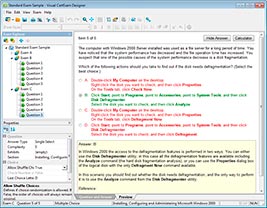
HOW TO OPEN VCE FILES
Use VCE Exam Simulator to open VCE files
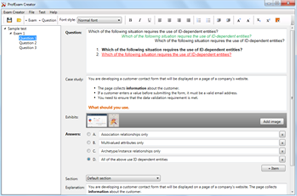
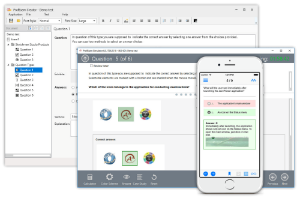
HOW TO OPEN VCEX AND EXAM FILES
Use ProfExam Simulator to open VCEX and EXAM files
ProfExam at a 20% markdown
You have the opportunity to purchase ProfExam at a 20% reduced price
Get Now!